


[KING'S CORNER] The Mist (2007)
Updated: Sep 7, 2025
The Mist - King's Corner Review
Welcome to King's Corner. A recurring series of reviews based on the film and TV adaptations of Stephen King's novels and collections, reviewed and released in order of the original source material publishing date.
Director: Frank Darabont
Starring: Thomas Janes, Marcia Gay Harden, Laurie Holden, Andre Braugher, Toby Jones, William Sadler
Written by: Frank Darabont
Produced by: Frank Darabont, Liz Glotzer,
Cinematography by: Rohn Schmidt
Original Score by: Mark Isham
Synopsis:
After a massive thunderstorm, an eerie, unwavering fog descends upon a Maine community. Locals seek refuge in a grocery store from the monstrous creatures now roaming the countryside killing everyone they encounter.

Thoughts:
Throughout his career as a writer one idea that Stephen King has come back to time and time again is the idea of faith and religion being openly critical of certain facets of it, like fundamentalism. In his first novel 'Carrie', Margeret White's extreme evangelical beliefs make her a despotic figure to her daughter. More recently in 'Revival', Methodist minister Charles Jacobs denounces religion in his Terrible Sermon which he delivers in the wake of his wife and child's sudden death. Prior to the release of that particular novel, King spoke about religion in an interview with Rolling Stone Magazine in 2014. During it he said, "My view is that organised religion is a very dangerous tool that's been misused by a lot of people." One such story that explores this criticism and many other societal issues is his novella, 'The Mist'.
The novella was first published in the anthology book 'Dark Forces: New Stories of Suspense and Supernatural Horror' in 1980. This was made up of 23 stories from different writers including Ray Bradbury and Richard Matheson. Later it was added to King's short story collection 'Skeleton Crew' which was published in 1985. In the notes section of this book he writes about the process of writing the story in the summer of 1976. At the time he was living in Bridgton, Maine and just like in the start of the story there was a huge thunderstorm. The day after he went to the supermarket with his son and the whole story opened up to him as he said, "By the time my son Joe and I were in the checkout lane, I was amusing myself with a story about all these people trapped in a supermarket surrounded by prehistoric animals."
In the documentary, 'When Darkness Came: The Making of The Mist' writer/director Frank Darabont talks about how in the early days of his career as a screenwriter he wanted to have a project in his back pocket he could one day go on to direct. The two he kept going between were 'The Mist' and 'The Shawshank Redemption'. He went with 'Shawshank' and the rest is history but he always had a desire to return to 'The Mist'. He first read the story in the 'Dark Forces' collection when it was first released and found it to be a very compelling story full of drama. King had known of Darabont's ambition to adapt the story so he held off giving away the rights to anyone else as he trusted him. When he secured the rights to the story he initially was developing the project for Paramount Pictures but they were dissatisfied with the ending of the script. Rather than change it Darabont stuck by it and eventually Bob Weinstein of Dimension Films offered to greenlight the film with the ending intact but he would have to make it on half the budget Paramount promised him. He agreed to it as long as he got to have final cut on the film.

One of the things that Darabont liked about the story was how it felt like an old fashioned creature feature. In an interview for the article, 'The Mist at 15: An Oral History Of Frank Darabont's Gut-Wrenching Stephen King Adaptation' he said, "It just reminded me of that sort of '50s, early '60s, low-budget, usually black and white, grainy kind of horror movie. It just felt like one of those things. And that appealed to me greatly as well." On that level it functions quite well. The dialogue is very pronounced and theatrical and whilst the CGI creature effects are quite janky by today's standards they work in paying homage to that era known for its dated but charming special effects. His preferred (and arguably superior) cut of the film is in black and white which only highlights his proposed direction with the film.
Primarily though, 'The Mist' is a film about human behaviour and the horrors that emerge from extreme pressure. When the things we rely on stop working, what do we do? Who are we really when disaster strikes? What extremities do we go to in order to survive and make sense of what is happening and what does this tell us about the true nature of ourselves? This exploration is the biggest strength of both the novella and Darabont's adaptation. The supermarket where the people of Bridgton take shelter from the mist acts like a microcosm for society in a similar way to the island the group of British schoolboys are stranded on in 'Lord of the Flies'. Tensions from the situation cause the people in the store to split into different groups. There are those trying to process what is happening in a rational manner, those who deny it even when the facts are right in front of them and those who give themselves over to religious extremism for salvation.
Anytime there is a real life disaster or a pandemic they act like a reminder for how timeless this kind of story is. For example, after the incident where the bag boy is dragged into the mist by a tentacled creature, it is clear that there is some kind of supernatural phenomenon in the mist and there is proof in the severed tentacle left behind in the failed rescue. In an attempt to explain this to everyone David (Thomas Jane) is met with resistance from his neighbour Brent (Andre Braugher) who refuses to even look at the evidence. This is clearly an analogy for the age of misinformation that we live in now where people refuse to acknowledge facts (even when presented with irrefutable evidence) as they are too stubborn and set in their ways to have their world view challenged or to admit that they were wrong

These viewpoints escalate as the film progresses and the threat from the mist becomes more potent. Darabont does a terrific job at escalating these tensions from interpersonal and external threats through the handheld manner in which he chose to shoot the film. Drawing on his experiences from directing some episodes of 'The Shield', he wanted to give the film a "fluid, ragged documentary kind of direction" (based on a 2015 interview with About Entertainment) which is why he hired some of the crew from that show to work on the film. The manner in which they get up close and personal with the actors adds a sense of gritty realism to the film and gives their actions more weight to the drama. You can argue that this makes the film more televisual but the manner in which Darabont employs these tools are what makes it more cinematic as he knows exactly when to lean into these aspects of his filmmaking and when to pull away from them.
Our guide through the film is artist David Drayton who is played by Thomas Jane. He is an everyday man with a loving wife and son who is dropped into a situation that is impossible to believe. As a conduit for the audience we easily identify with him as he tries to do what he thinks is best for everyone even when he makes mistakes. The calmness that Jane tries to convey and his attempt to maintain a sense of control despite the spiralling madness makes him relatable and someone we all think we would be like in this scenario. He isn't impervious to what is happening though as there are chinks to Jane's emotional armour that appear throughout before coming to a head in the final moments of the film that make it easy to see why he was Darabont's first choice for the role.
Amidst the ensemble cast the one performance that stands out is the religious zealot of the town Mrs. Carmody (Marcia Gay Harden). Early in the film, the assistant manager of the supermarket, Ollie (Toby Jones) says that, "Mrs. Carmody is known to be unstable". That turns out to be an understatement as she is the personification of the dangers of religious extremism. Her beliefs are tied to the God of the Old Testament believing that what is happening is a punishment from him and that she is a vessel for his will. As the situation worsens in the store she preys upon the fear of the people in the store to the point where she convinces them that sacrifices are necessary for their survival. There is a reason why Mrs. Carmody is one of the greatest King villains portrayed on the big screen and that is primarily because of Marcia Gay Harden's performance. On the page she is pure hellfire and brimstone in her rhetoric with a misplaced sense of self righteousness as she pontificates about the end of the world. This could make for a very one dimensional character but Harden's portrayal of it is what makes it a terrifying yet compelling performance. She grows in confidence as the situation worsens but there is a hypocrisy in how she looks down on everyone not on the same wavelength as her and this shines through Harden's glances and grimaces showing the audience that stripped of her religion she is nothing more than a despicably miserable person.

Whilst these performances are terrific, 'The Mist' really is an ensemble effort where almost every character gets a moment to shine. When you have a cast that includes the likes of William Sadler, Laurie Holden, Jeffrey DeMunn, Toby Jones and Frances Sternhagen (amongst others I have previously mentioned) you know you are in for something great from a dramatic perspective. They give the B-Movie elements of the script more gravitas and the way they interact with each other makes it feel like a play which works incredibly well.
When you discuss 'The Mist' in any way, shape or form the main talking point will always be around the ending. In the novella, David and a small band of survivors are given a shred of hope by hearing "Hartford" on a radio signalling that there may be a safe haven beyond the mist. Darabont takes a different approach to this and one which King complimented him on as being a better ending to what he came up with. It starts the same with David, his son and three other survivors escaping the madness of the supermarket to try and find a way out of the mist. During most of the film you are trapped in the supermarket so once you are outside it, the scale of what has happened hits home for the characters and audience alike. The world opens up again to them but it is engulfed in the seemingly inescapable mist. David passes his home to find his dead wife cocooned in webs, there is widespread destruction and they come across what can only be described as a behemoth straight from the imagination of H.P. Lovecraft. It is a tremendous piece of cosmic horror that evokes a feeling of terrifying awe. Through this montage the song 'Host of Seraphim' by Dead Can Dance plays which generates a feeling of hopelessness in how apocalyptic the unleashing of the mist has become.
Eventually the truck runs out of fuel. There is nothing to see around them. All that remains are the five survivors and the gun in David's hands containing four bullets. Knowing what awaits them outside, he mercy kills them all leaving himself alive. Distraught, he staggers out of the truck willing something from within the mist to put him out of his misery. What he gets instead is salvation as a tank billows through the mist clearing it to reveal the army in full force alongside more survivours. David is left inconsolable knowing his actions were for nothing. It is one of the cruelest endings to any film (nevermind an adaptation of King's work) but also the right one. The whole film is about what people are capable of under extreme pressure be it the right or wrong. In this case David gets it wrong but his circumstances at that given moment make it understandable. Every experience up to this moment suggests that he is doing the right thing but then the cruel hand of fate intervenes to show him the error of his ways. In his interview in 'The Mist at 15' article Darabont says, "Sometimes shit doesn't work out and sometimes you made the wrong decisions even if you meant well. Life is like that. Life doesn't always hand you a happy ending, does it? In fact, I wonder more often than not if it doesn't."
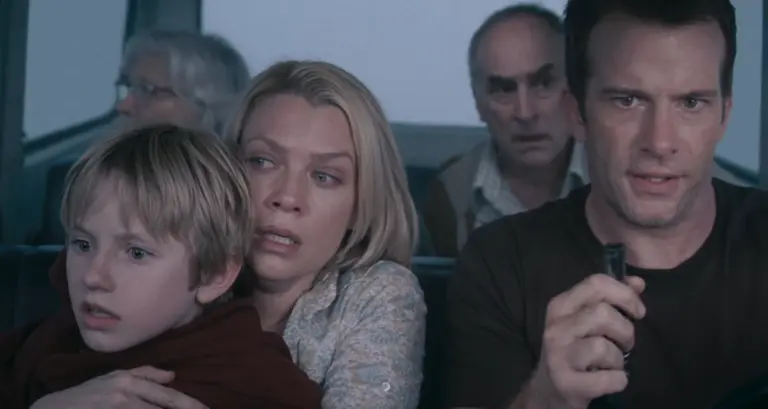
If there was any doubt over whether Frank Darabont has a place on the Mount Rushmore of directors who have adapted King's work over the years, 'The Mist' safely secures his place there. Whilst 'The Shawshank Redemption' and 'The Green Mile' were more dramatic in tone, he goes completely down the horror route with this film showing his versatility in adapting different genres of King's material. As an examination of human behaviour under duress, the film works brilliantly as it is a universal theme that could apply to any group of people from any cultural background. As well as this it also works as a homage to the creature features of yesteryear but the harrowing finale is what makes it one of the great horror films of the 2000s.
Verdict: ⭐️⭐️⭐️⭐️
-Joseph McElroy
![[KING'S CORNER] Silver Bullet (1985)](https://static.wixstatic.com/media/cc392c_692762dd9cff4ed19a30014bc7c6ba9c~mv2.jpg/v1/fill/w_613,h_460,al_c,q_80,enc_avif,quality_auto/cc392c_692762dd9cff4ed19a30014bc7c6ba9c~mv2.jpg)
![[KING'S CORNER] The Shawshank Redemption (1994)](https://static.wixstatic.com/media/cc392c_66ade99e1bed4f3db5f42f78f15104a3~mv2.jpg/v1/fill/w_980,h_613,al_c,q_85,usm_0.66_1.00_0.01,enc_avif,quality_auto/cc392c_66ade99e1bed4f3db5f42f78f15104a3~mv2.jpg)
![[KING'S CORNER] The Green Mile (1999)](https://static.wixstatic.com/media/cc392c_0c194cc540d440bc87b414fa9367558e~mv2.jpg/v1/fill/w_980,h_613,al_c,q_85,usm_0.66_1.00_0.01,enc_avif,quality_auto/cc392c_0c194cc540d440bc87b414fa9367558e~mv2.jpg)
Comments