


[KING'S CORNER] 1408 (2007)
Updated: Aug 27
1408 - King's Corner Review
Welcome to King's Corner. A recurring series of reviews based on the film and TV adaptations of Stephen King's novels and collections, reviewed and released in order of the original source material publishing date.
Director: Mikael Håfström
Starring: John Cusack, Samuel L. Jackson, Tony Shalhoub, Mary McCormack
Written by: Matt Greenberg, Scott Alexander, Larry Karaszewski
Produced by: Lorenzo di Bonaventura
Cinematography by: Benoît Delhomme
Original Score by: Gabriel Yared
Synopsis:
Author Michael Enslin, who specializes in debunking paranormal occurrences, checks into the fabled room 1408 in the Dolphin Hotel in New York City, settles in, and soon confronts genuine terror.

Thoughts:
Hotel rooms can be a nightmare. The temperamental temperature controls, the enigma over what handle is used to start the shower and arguably worse of all is the lack of milk in the tea making facilities which all can lead to an unpleasant experience. The only thing that can make it worse is the presence of a supernatural entity. Over the years there have been countless stories that have covered this trope but one of the most famous comes from Stephen King’s novel, The Shining. I doubt anyone can ever forget about the bloated rotting corpse of the woman who emerges from the bathtub in room 217. As unforgettable as this moment and many other moments in the story are, they often overshadow another ghostly story from King where a hotel room plays a prominent role. That is '1408'.
The origins of the story stretch back to Stephen King’s book 'On Writing' which was his memoir on his life as a writer. In the appendix of this book he wrote the first few pages of a story in the vein of what he calls the "Ghostly Room at the Inn" trope to show an example of the redrafting process but in doing so he saw potential in the story, so he fleshed it out to what would become '1408'. The story follows Mike Enslin, a cynical writer whose work focuses on the paranormal. He decides to stay in a notorious room in a New York city hotel that is said to be a place of evil but to him it is a source of inspiration for his next book. Sure enough he soon finds out that things aren’t what they seem to be as he gets more than he bargained for. The story was first released solely as an audiobook (read by King) in the anthology collection 'Blood and Smoke' in 1999 and eventually it was added to the collection, 'Everything’s Eventual' in 2002.
In November 2003, Dimension Films optioned the short story to be developed into a feature film for the studio. The studio hired writer Matt Greenberg to write the script. By October 2005 Swedish filmmaker Mikael Håfström was hired to direct the film with duo Scott Alexander and Larry Karaszewski being hired to rewrite the script. By March the following year John Cusack was hired to play the lead role in the film and it was off to the races from there for its journey to the big screen.
The short story is one of two halves; the sceptical author being warned about the room by the hotel manager and his stay in the room. It is a solid framework to delve deep not just into the history of the room but to explore the background of the skeptical author Mike a lot more. The script certainly achieves this in a way that doesn’t seem forced or abrupt as Mike’s troubled past is tied to and exacerbated by almost every terrifying scenario the room throws at him.
As the majority of the film is spent with Mike alone in the room, the film requires an actor with great presence and charisma to carry this aspect of the film and to a large extent John Cusack achieves this. When we are introduced to him, Cusack paints Mike as a very distant and cynical character who has a bitter edge to him. It leads him to write about something he resents in retaliation to his daughter’s death rather than something he is passionate about which is hinted at during his book signing. There is a haunted quality to Cusack in the withdrawn manner he carries himself but he isn’t afraid to let his cynicism shine through, particularly in the scene where he is talking to Olin (Samuel L. Jackson), the manager of the Dolphin hotel which contains the infamous room 1408. His closed mindedness and refusal to acknowledge his warnings with a simple arrogant response of having heard it all before when researching material for his writings on the supernatural.
Like the story being a tale of two halves, so too is Cusack's performance. As the room torments him with one horror after another Cusack’s performance becomes more unhinged and over the top in the face of the inexplicable and surreal terror he faces. The nature of it is akin to a grandiose style that Nicholas Cage often employs in his performances. The prime example of this is when he has a vision of Olin in the fridge and has an argument with him, tossing the contents of the fridge all over the room in an over the top manner. Despite this he retains a sense of tragedy to his performance which comes to a head when he speaks to a vision of his daughter that ends in a devastating manner towards the end of the film.

It is a cliché to describe a setting as a character but in the case of 1408 it is justified because it is not a room that is haunted by some malevolent spirit as Olin puts it in much simpler terms saying, “it’s an evil fucking room” which is much more interesting in how it generates a greater sense of horror in the imagination. When Mike enters the room it seems like a fairly basic if not old fashioned room where nothing seems out of the ordinary. The way in which Håfström dispels any notion of safety through the manner in which he shoots the scenes in the room makes it feel like an all encompassing force has Mike in the palm of its hands. This fear becomes a reality as it toys with him like a predator with its prey by gradually increasing Mike’s anxiety and testing his beliefs. The Carpenters song, 'We've Only Just Begun' plays by itself on the alarm radio, the heating system fluctuates and then the visions of ghosts appear to slowly chip away at the wall of cynicism that protects his emotionally fragile mind. He tries to escape but the room won’t let him leave as it taps into his traumatic past with his daughter and the strain in his relationship with his father and wife pushing Mike to the brink in a gleeful manner to the room. It plays out like a checklist for the kind of popcorn horror you’d get in a James Wann film.
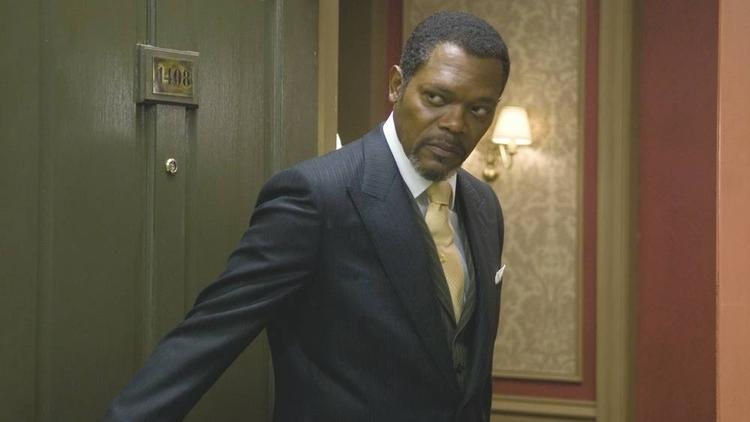
Before we even enter the room Samuel L. Jackson does a brilliant job at selling the dangers that lurk in the room. When he first meets Mike the camera moves in a circle around them showing how their meeting is going to be a clash between sceptic and believer. Even though Mike doesn’t buy what Olin is selling as he’s been through this scenario countless times before, we as an audience do because there are few actors who can sell spooky expository dialogue better than Jackson. It may be a small role but it is one that Jackson relishes.
A lot of films produced by Dimension over the years suffered at the meddling hands of the Weinsteins and '1408' is no different as it has four different endings. The main ones though are the theatrical and the director's cut. In the theatrical cut, Mike survives his ordeal and reconciles with his wife. Although this is closer to the original end of the short story it is a betrayal to the thematic ideas that preceded it in this adaptation. The directors cut in this sense makes a lot more sense as Mike dies in the room fully giving himself over to the forces he denied having existed prior to his stay in 1408. In doing so it offers him a sense of closure to his daughter’s death knowing how in some way she lives on offering him a bleak sense of closure.

'1408' is a good example of taking a simple short story and fleshing it out to make it a worthy venture for the big screen. Cusack is a solid lead to guide the audience through hell, addressing his demons along the way even if it sacrifices the more interesting psychological elements of the story for something more flashy and mainstream. Alongside it though, the expansion of Mike’s backstory is what improves upon the source material and allows the audience to engage more with such a cold character. Out of the three King adaptations Cusack starred in (alongside Cell and Stand By Me) '1408' sits comfortably in the middle.
Verdict: ⭐️⭐️⭐️½
-Joseph McElroy
![[KING'S CORNER] The Cat from Hell (1990)](https://static.wixstatic.com/media/cc392c_f6bb75d5578d4a5ea1541f184265c949~mv2.jpg/v1/fill/w_980,h_490,al_c,q_85,usm_0.66_1.00_0.01,enc_avif,quality_auto/cc392c_f6bb75d5578d4a5ea1541f184265c949~mv2.jpg)
![[KING'S CORNER] The Road Virus Heads North (2006)](https://static.wixstatic.com/media/cc392c_46ab9c412c554f8fa3d8b864a6d69a34~mv2.jpg/v1/fill/w_980,h_674,al_c,q_85,usm_0.66_1.00_0.01,enc_avif,quality_auto/cc392c_46ab9c412c554f8fa3d8b864a6d69a34~mv2.jpg)
![[KING'S CORNER] Autopsy Room Four (2006)](https://static.wixstatic.com/media/cc392c_9e37a9aabc0245ef8c4565941c37fa03~mv2.jpg/v1/fill/w_980,h_551,al_c,q_85,usm_0.66_1.00_0.01,enc_avif,quality_auto/cc392c_9e37a9aabc0245ef8c4565941c37fa03~mv2.jpg)
Comments