


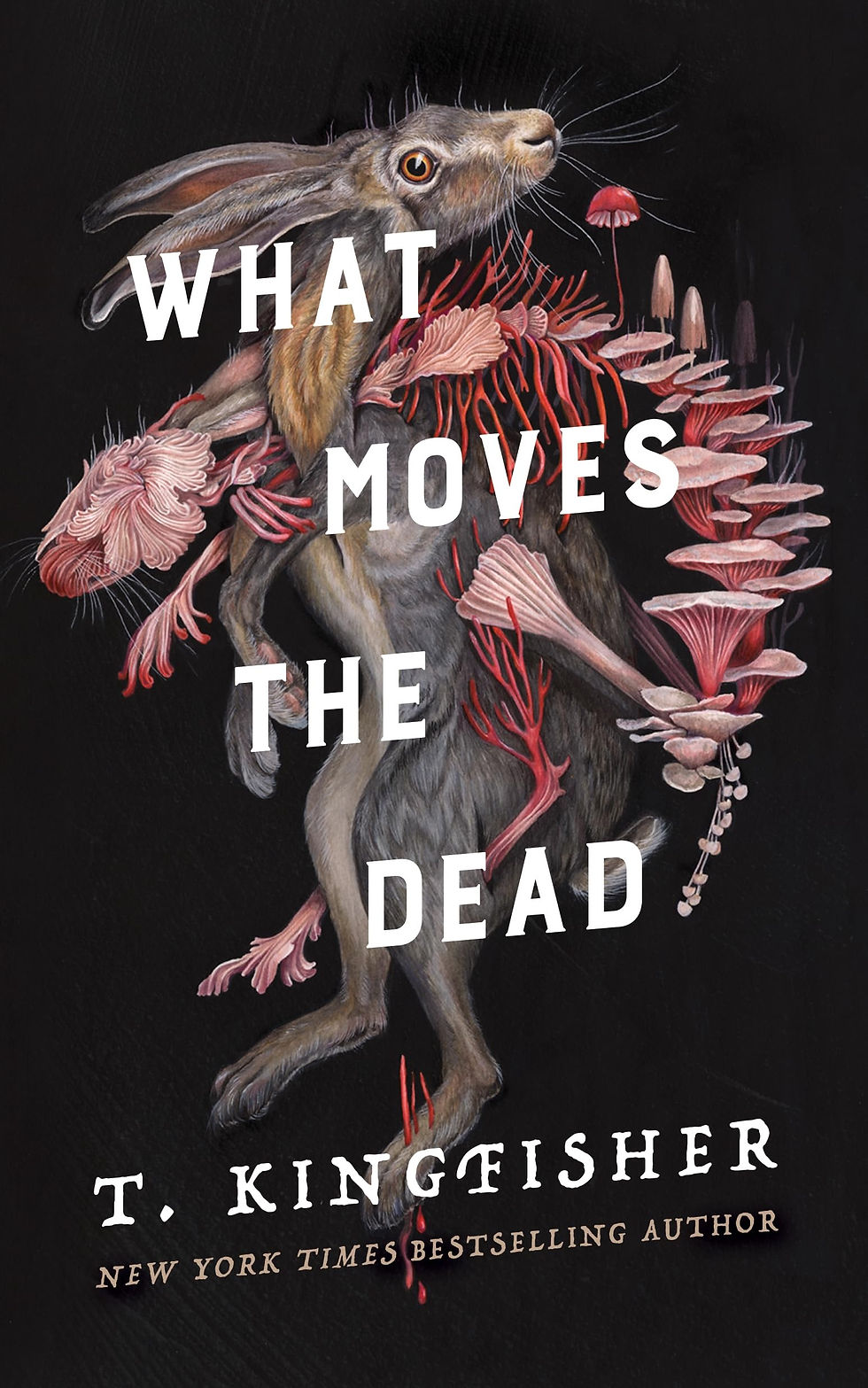
[BOOKS OF THE DEAD] What Moves the Dead - T Kingfisher
What Moves the Dead - Books of the Dead Review
Welcome to Books of the Dead. A monthly series by published author and founder of The Readers in the Rue Morgue Book Club Victoria Brown where she deep dives into some her favourite (and not so favourite) authors and books.
Author: T. Kingfisher
Publication Date: 18/10/22
Synopsis: When Alex Easton, a retired soldier, receives word that their childhood friend Madeline Usher is dying, they race to the ancestral home of the Ushers in the remote countryside of Ruritania.
What they find there is a nightmare of fungal growths and possessed wildlife, surrounding a dark, pulsing lake. Madeline sleepwalks and speaks in strange voices at night, and her brother Roderick is consumed with a mysterious malady of the nerves.
Aided by a redoubtable British mycologist and a baffled American doctor, Alex must unravel the secret of the House of Usher before it consumes them all.
Thoughts:
I have read many retellings of gothic literature, including ‘Dracula’, ‘The Strange Case of Doctor Jekyll and Mr Hyde’, ‘Frankenstein’, ‘The Island of Doctor Moreau’, and ‘The Legend of Sleepy Hollow’, but this was my first Edgar Allan Poe retelling. Writer and artist T. Kingfisher (real name Ursula Vernon – she writes adult literature with a pen name to separate it from her work for younger audiences) tackled one of Poe’s most enduring tales, 1839’s ‘The Fall of the House of Usher’, in ‘What Moves the Dead’ and she did a fantastic job.
To my pleasant surprise, Kingfisher stuck to the main plot points, language style, themes and motifs of the original short story, including ancestral madness and mental instability, death and deterioration, and the supernatural (or what appears to be at first), and the parts she did change to make the tale her own worked well in the context of the story.
In Poe’s tale, the unnamed narrator is an old friend of Roderick and Madeline Usher, once-rich twins who live alone in their isolated ancestral home that is crumbling down around them. The narrator travels to their home after receiving a letter from Roderick where he complains he is ill. ‘What Moves the Dead’ opens in a similar fashion, but it gives the narrator a name – Alex Easton – and a backstory. Easton was in the army with Roderick, an exceptional bond that goes beyond regular friendship for they share the same harrowing memories, and is not, in fact, your typical soldier. Easton’s home country is one where gender is fluid and flexible, with unique pronouns to describe one’s identity. This does not feel forced or unearned – it is woven so intricately into the story that you barely notice it. This approach to Easton’s character gives them much more depth than the original unnamed narrator, and Kingfisher does a wonderful job of making them full of curiosity, experience, and agency, and makes the readers believe in their motivations to help the Ushers.
The biggest change Kingfisher makes is providing a scientific explanation for the madness that has gripped the twins and ultimately leads to their deaths and the fiery destruction of their home (no spoilers, it’s an OLD story). In Poe’s tale, it is implied that the cause is supernatural and is left purposely ambiguous – one of the oldest tricks in horror is letting a reader’s imagination imagine the horrific possibilities for themselves – but Kingfisher takes a different route. She wanted an explanation, so she created one.
Throughout the story, Roderick and Madeline show all the classic Poe signs of madness – paranoia, physical wasting and weakness, speaking in odd voices, not remembering where they are – and this continues in ‘What Moves the Dead’, but with one key addition: hares. The hares on the Usher’s land do not skitter and start the way regular hares do, and this freaks out not only Easton, but the Usher’s friend, their doctor, and a spores expert who is on the Usher’s land to capture scientific samples. The hares exhibit the same behaviours as Madeline, and it soon becomes clear through thorough investigation of a hare’s dead body (or what appears to be dead), that a fungus unique to the Usher’s land is poisoning Madeline, the lake, and all the animals.
This would have been a great explanation on its own, for it makes scientific sense, but Kingfisher goes one step further and makes the fungus sentient. I won’t go into detail, but it’s creepy as hell.
Retellings can be difficult to pull off, and I have read some bad ones, but Kingfisher’s take on the classic Poe tale is a well-balanced mix of gothic, science, dry humour, and agency. A beautiful piece of work.
Verdict: ⭐️⭐️⭐️⭐️½
-Victoria Brown, Author of The Death Ship: Recovering The Bodies of Titanic's Dead
![[BOOKS OF THE DEAD] Heads Will Roll - Josh Winning](https://static.wixstatic.com/media/cc392c_83a7270e2b1f47a7ba5862688adb547d~mv2.jpg/v1/fill/w_980,h_1499,al_c,q_85,usm_0.66_1.00_0.01,enc_avif,quality_auto/cc392c_83a7270e2b1f47a7ba5862688adb547d~mv2.jpg)
![[BOOKS OF THE DEAD] The Eyes Are the Best Part - Monika Kim](https://static.wixstatic.com/media/cc392c_fd311fce4ecf4fa092d2c9e261cd3807~mv2.jpg/v1/fill/w_980,h_1540,al_c,q_85,usm_0.66_1.00_0.01,enc_avif,quality_auto/cc392c_fd311fce4ecf4fa092d2c9e261cd3807~mv2.jpg)
![[BOOKS OF THE DEAD] All the Fiends of Hell - Adam Nevill](https://static.wixstatic.com/media/cc392c_26577f5c43f74e3e8432de52e626bc2c~mv2.jpg/v1/fill/w_880,h_1360,al_c,q_85,enc_avif,quality_auto/cc392c_26577f5c43f74e3e8432de52e626bc2c~mv2.jpg)
Comments